Prompt Engineering Has a Ceiling: Here Is Where It Is
Prompt engineering has an implicit and widely misunderstood ceiling. For any given model and task, there exists a best achievable performance under prompting constraints, and that ceiling is often lower than what production requires. The engineers who hit it earliest are those working on structured extraction, multi-class classification, and domain-specific generation, where model behavior needs to be consistent across thousands of requests rather than impressively correct on a single demo. Below that ceiling, prompting is the right tool: it is fast to iterate, requires no training infrastructure, and can be applied to off-the-shelf model APIs. Above it, prompting produces diminishing returns while fine-tuning, RAG, or architectural changes can produce step-function improvements. The mistake most teams make is spending weeks refining a prompt for a task that sits structurally above the prompting ceiling, when the right move was to reach for a different tool three weeks earlier.
The prompting stack: each rung and its cost
Zero-shot prompting is the baseline: state the task and let the model respond. For tasks the model has seen extensively in pre-training, including summarization, question answering over short passages, and basic code generation, zero-shot performance is often adequate. The cost is near-zero: the prompt is concise and the model processes it in a single forward pass.
Few-shot prompting adds example input-output pairs to the prompt. The model conditions its output on the pattern demonstrated by those examples. For structured extraction tasks such as parsing dates, extracting named entities, and formatting data, few-shot prompting typically improves accuracy by 5 to 15 percentage points over zero-shot. The cost is proportional to the number of examples: 8 examples of 200 tokens each add 1,600 tokens to every request. At GPT-4o pricing of $2.50 per million tokens, 1,600 tokens of few-shot context at 10 million requests per month adds $40,000 per month to input token costs. That is not a reason to avoid few-shot prompting when it works, but it is a number worth knowing before you commit to it at scale.
Chain-of-thought (CoT) prompting asks the model to reason step by step before producing a final answer. For multi-step reasoning tasks, mathematics, logical inference, and multi-hop question answering, CoT improves performance substantially. Wei et al. (2022) showed that CoT-prompted GPT-3 (175B) outperforms standard prompting by 18 percentage points on the GSM8K math benchmark. The cost is output token volume: a CoT response for a complex reasoning problem may be 200 to 400 tokens longer than a direct answer, doubling or tripling output token cost per request.
Self-consistency samples k responses, typically k=10 to 40, and takes the majority answer. For arithmetic and factual tasks, self-consistency over 10 CoT samples achieves a further 5 to 10 percentage point improvement over single-sample CoT. The cost is k times the single-sample cost: at k=10 with CoT, each request costs 10x the compute of a zero-shot request. Wang et al. (2023) demonstrated this improvement consistently across multiple reasoning benchmarks, but the economics only hold if the value of the additional accuracy justifies the 10x cost increase.
Tree of Thought (ToT) explores multiple reasoning paths in parallel, using the model to evaluate and prune paths, and terminates on the highest-scoring path. Yao et al. (2023) showed ToT achieves the highest performance of any prompting approach on complex planning and reasoning tasks. The cost is tens to hundreds of model calls per request. At GPT-4o pricing, a complex ToT run can cost $0.10 to $1.00 per request, making it viable only for tasks where the value per request justifies the cost, which in practice means high-value asynchronous workflows, not real-time user-facing applications.
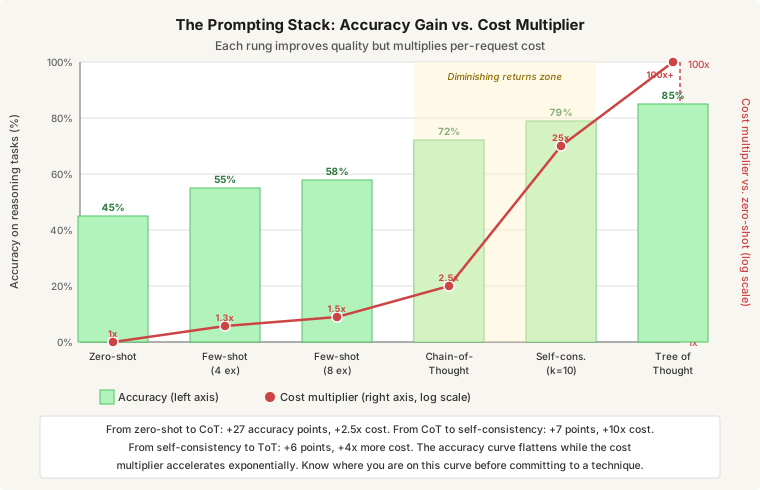
From zero-shot to CoT, you gain 27 percentage points at 2.5x cost. From CoT to self-consistency, you gain 7 points at 10x cost. The curve flattens sharply while the cost multiplier accelerates. Knowing where you are on this curve before committing to a technique is the core skill in prompt engineering.
Quantified ceilings by task type
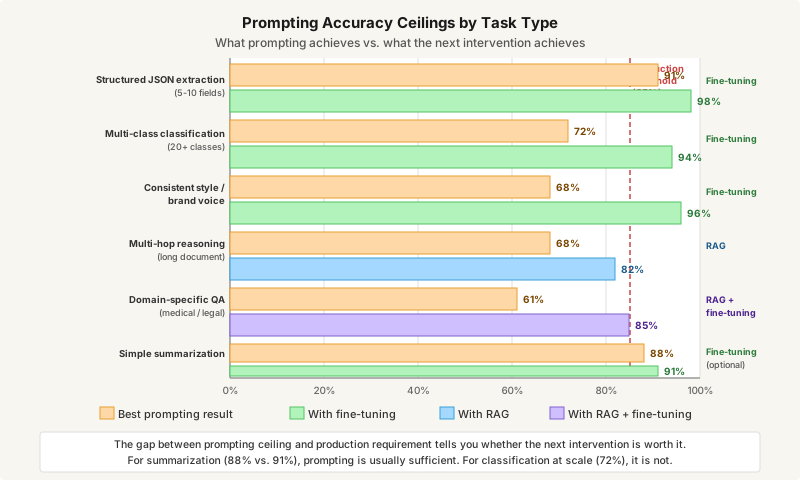
The ceiling is not abstract. For the task types that matter most in production, there are concrete numbers derived from published benchmarks and internal production data.
Structured extraction, meaning extracting structured data such as JSON fields, normalized values, and typed attributes from unstructured text, is one of the earliest places the ceiling appears. Few-shot CoT prompting plateaus at approximately 90 to 93% field-level accuracy on tasks with 5 to 20 fields. Above 20 fields, accuracy degrades further because the model cannot hold the full schema in reliable attention across the sequence. Fine-tuning consistently reaches 97 to 99% on the same tasks by making the schema a trained behavior rather than an in-context instruction competing with the model's pre-trained tendencies. The 7 to 9 percentage point gap between 90% and 97% sounds small until you are processing 100,000 records per day and that gap is 7,000 to 9,000 malformed records requiring manual correction.
Multi-class classification assigns one of k labels to an input. Few-shot prompting peaks at approximately 80 to 88% accuracy for k up to 10 classes. For k=20 to 50 classes, performance degrades to 60 to 75% because the model cannot reliably distinguish rare classes from a few examples each. Fine-tuning on 500 to 2,000 examples per class achieves 92 to 97% accuracy at any class count. The problem is not that the model lacks the concept of fine-grained classification; it is that in-context learning cannot reliably encode 20 to 50 distinct decision boundaries from a handful of examples each.
Open-ended generation, covering creative writing, summarization, and dialogue, sits at a different point on the ceiling curve. Prompting can achieve near-target quality for many applications, and the ceiling is high enough that fine-tuning rarely adds meaningful accuracy improvement. The one dimension where fine-tuning adds substantial value for generation tasks is consistency: reliable production of the same style, voice, and format across thousands of responses with diverse inputs. A fine-tuned model will maintain a specific brand voice reliably. A prompted model will drift as the input complexity increases, the conversation grows longer, or the topic approaches an edge case the prompt did not anticipate. Consistent style is the one thing fine-tuning achieves that prompting cannot consistently replicate.
Reasoning over long documents exposes a ceiling that is structural rather than resolvable through better prompting. For questions requiring integration of information from multiple locations in a long document, prompting with the full document and a query achieves 60 to 75% accuracy on multi-hop questions. This ceiling is imposed by the lost-in-the-middle effect covered in Post 2: relevant content in the middle of a long context receives less attention weight than content near the beginning or end, and no prompt instruction can override a positional attention bias. RAG with well-designed chunking and retrieval can exceed this ceiling by ensuring relevant content is always placed in a favorable context position, regardless of where it originally appeared in the source document.
Domain-specific question answering, covering medical, legal, and technical domains, has a knowledge ceiling in addition to a structural one. When the model lacks domain knowledge that is not present in its pre-training data, whether because the knowledge is too recent, too specialized, or too proprietary, prompting with the query cannot supply what is missing. The prompting ceiling for domain QA on specialized knowledge is approximately 61% on tasks requiring recent or highly specific knowledge. RAG combined with fine-tuning for consistent response format reaches 85% on the same tasks.
In-context learning limit: why the 17th example does not help
The performance gain from few-shot examples follows a diminishing returns curve. Moving from 0 to 1 example produces the largest improvement. Moving from 1 to 4 examples produces further improvement. Moving from 4 to 8 examples produces smaller improvement. Beyond 8 to 16 examples, additional examples typically produce no improvement and may degrade performance.
The mechanistic explanation is rooted in how attention distributes across a long context. When the model has 16 examples plus the target input in its context, it attends to the pattern established by the examples through cross-example attention. With 32 examples, the attention distribution over the examples becomes more diffuse: each individual example receives a smaller share of total attention capacity (Post 1 on attention mechanisms explains this in detail), and later examples have diminishing influence per example on the output. The signal from each additional example decreases as total example count increases.
There is also a selection effect that compounds this: the first few examples were the most representative ones, chosen because they clearly demonstrate the pattern. Additional examples tend to be corner cases that the model already handles correctly from the first few examples, so they add noise rather than signal. Min et al. (2022) showed that even the content of the labels in few-shot examples matters less than commonly assumed: what drives in-context learning is the format and distribution of the examples, not necessarily the precise label mapping. This is counterintuitive but it has a practical implication: if additional examples are not improving performance, they are genuinely not helping, and the issue is not that you need more examples of the same type.
The practical implication is concrete: more than 8 to 12 examples in a few-shot prompt is almost never useful and always expensive. If you need more than 12 examples to achieve acceptable performance, you have passed the prompting ceiling for that task and need fine-tuning. Zhao et al. (2021) showed that the ordering and selection of few-shot examples can produce variance of up to 30 percentage points on the same task, which means time spent calibrating example selection up to 8 examples is well spent, and time spent adding examples beyond that is not.
The diagnostic test: separating model gap from prompt gap
Before concluding that a task requires fine-tuning, it is worth establishing whether the limitation is the model's capability or the prompt's quality. The distinction matters because the two require fundamentally different interventions.
The diagnostic is an oracle test: construct a prompt with perfect, task-specific chain-of-thought reasoning for each example in your evaluation set. This is not a practical deployment configuration; it is a diagnostic upper bound. For each evaluation example, write the ideal step-by-step reasoning that a human expert would use to arrive at the correct answer, and include it in the prompt as context. If the oracle-prompted model achieves the target accuracy, the gap is a prompting gap: the capability exists in the model, but you have not found the right way to express the task. Better prompts, better examples, or CoT elicitation can close the gap. If the oracle-prompted model still fails to reach the target accuracy, the gap is a model gap: no prompt can supply capability the model does not have.
The oracle test requires human effort to construct the reasoning traces, which is time-consuming. But it is far less expensive than training a fine-tuned model only to discover that the base model cannot perform the task regardless of training signal. If the model gap is the issue, fine-tuning on task-specific data helps only if the model's architecture and pre-training have enough relevant knowledge to be surfaced by additional training. For tasks requiring knowledge the model genuinely lacks, fine-tuning on limited examples does not close the gap; it only overfits to the fine-tuning distribution.
Common model gaps that prompting cannot close fall into recognizable categories. Tasks requiring knowledge the model does not have are solved with RAG or retrieval tools, not with prompt elaboration. Tasks requiring consistent style across thousands of responses are solved with fine-tuning, not with increasingly detailed style instructions in the prompt. Tasks requiring inference speed below 200ms time-to-first-token at high volume are solved with a smaller model combined with fine-tuning or distillation, not with a larger model prompted more carefully. Tasks requiring structured outputs with more than 20 fields reliably are solved with fine-tuning combined with constrained decoding, not with longer schema descriptions in the prompt.
The cost of long system prompts at scale
A 2,000-token system prompt is a common artifact of iterative prompt engineering: each new edge case adds a sentence, each new requirement adds a paragraph, until the prompt contains 50 paragraphs of instructions, examples, and caveats that have accumulated over weeks of refinement. The prompt works in the sense that it passes evaluation on the original test set. The problems are cost and attention degradation at scale.
At GPT-4o pricing of $2.50 per million input tokens, a 2,000-token system prompt costs $0.005 per request. At 10 million requests per day, that is $50,000 per day, $1.5 million per month from the system prompt alone. This is before any few-shot examples, before the user query, and before any retrieved content. The system prompt cost is the fixed overhead paid on every single request regardless of its complexity.
Long system prompts also hit a structural ceiling of their own: the lost-in-the-middle effect applies to instructions as well as content. Instructions at the beginning of the system prompt are attended to more reliably than instructions buried in the middle. A 50-paragraph system prompt effectively has an implicit hierarchy where early instructions dominate late ones, which is rarely the intended behavior. Teams that audit large system prompts typically find that instructions in the middle third of the prompt are being inconsistently followed, because the model is attending to them with lower weight. These instructions are expensive noise: they add token cost to every request while providing unreliable behavioral control.
The right direction when a system prompt grows beyond 500 tokens is a prompt audit: which instructions are actually being followed, and which are being ignored because they are buried in the middle of a dense instruction block? Instructions that are being ignored should be removed, restructuring the remaining instructions for clarity. Instructions that are critical should be moved to the beginning or end of the prompt, where positional attention favors them. Instructions that represent consistent behavior the model should always exhibit regardless of input are better candidates for fine-tuning than for a longer prompt. A fine-tuned model that always formats its output correctly costs zero tokens to instruct on format; a prompted model costs however many tokens the formatting instruction requires, multiplied by every request.
The transition criteria
The right time to move from prompting to fine-tuning is when consistency is the requirement, not accuracy. Prompting can achieve high accuracy on a per-example basis but cannot guarantee that the model will consistently follow a specific pattern across thousands of requests with diverse inputs, long conversations, and edge cases the prompt did not anticipate. Fine-tuning bakes a pattern into the model's weights, making it the default behavior rather than an in-context instruction that competes with the model's pre-trained tendencies. The transition signal is when accuracy on a held-out evaluation set is adequate but consistency metrics, meaning the fraction of responses that conform to the required format, style, or structure, remain below acceptable thresholds after prompt refinement.
The right time to move from prompting to RAG is when the task requires knowledge the model does not have or knowledge that changes over time. This is distinct from capability: the model may be fully capable of reasoning about the domain but simply lacks the specific facts. Prompting with retrieved content as a preliminary technique is not the same as production RAG: properly built RAG includes retrieval infrastructure, chunk management, embedding indexes, reranking, and fallback handling. The transition signal is when the model's failure mode is consistently "the model does not know the answer" rather than "the model reasons incorrectly about the answer." The former requires retrieval; the latter requires better reasoning elicitation or fine-tuning.
The right time to move from prompting to architecture changes, meaning a smaller model, latency optimization, or distillation, is when the latency or cost of the current model configuration exceeds what the application can sustain. A 2-second time-to-first-token is acceptable for a research assistant used asynchronously but not for a customer-facing chat interface where users expect sub-second response initiation. Self-consistency and ToT improve quality by multiplying compute per request, which moves in the wrong direction when latency is the binding constraint. The transition signal is when the quality requirements and the latency requirements are simultaneously satisfiable only at a cost that exceeds the product's economics. At that point, the question is not which prompting technique to use but which smaller, faster model can be fine-tuned to deliver the required quality.
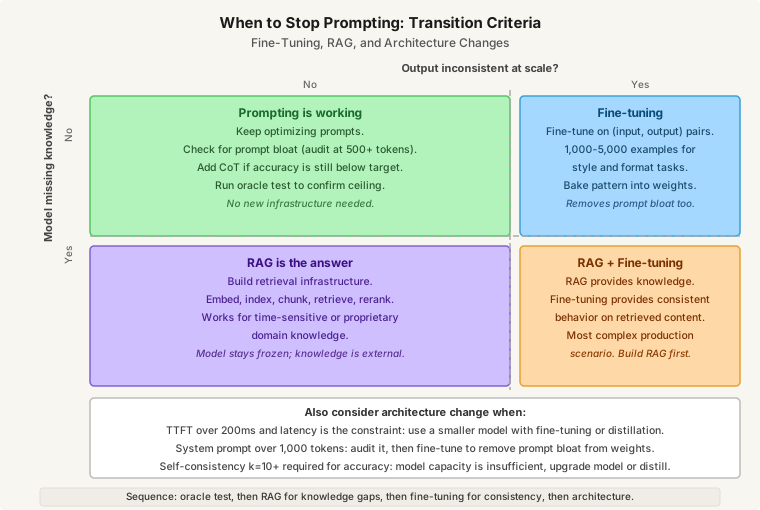
The sequence matters as much as the criteria. The correct order is: establish the prompting ceiling with the oracle test, then apply RAG if the failure mode is a knowledge gap, then apply fine-tuning if the failure mode is consistency or a persistent accuracy gap, then apply architecture changes if the failure mode is latency or cost. Each step is substantially more expensive to build and maintain than the one before it. The goal is to stop as early as possible in the sequence while meeting the production requirement. Teams that skip this sequence and jump directly to fine-tuning because a demo performed poorly on a few examples often discover that better prompting would have been sufficient, and teams that persist with prompting past the point where the oracle test has clearly identified a model gap are spending engineering time that cannot close the gap they are chasing.
References
Wei, J., Wang, X., Schuurmans, D., et al. "Chain-of-Thought Prompting Elicits Reasoning in Large Language Models." NeurIPS, 2022. https://arxiv.org/abs/2201.11903
Wang, X., Wei, J., Schuurmans, D., et al. "Self-Consistency Improves Chain of Thought Reasoning in Language Models." ICLR, 2023. https://arxiv.org/abs/2203.11171
Yao, S., Yu, D., Zhao, J., et al. "Tree of Thoughts: Deliberate Problem Solving with Large Language Models." NeurIPS, 2023. https://arxiv.org/abs/2305.10601
Brown, T., Mann, B., Ryder, N., et al. "Language Models are Few-Shot Learners." NeurIPS, 2020. https://arxiv.org/abs/2005.14165
Min, S., Lyu, X., Holtzman, A., et al. "Rethinking the Role of Demonstrations: What Makes In-Context Learning Work?" EMNLP, 2022. https://arxiv.org/abs/2202.12837
Zhao, Z., Wallace, E., Feng, S., Klein, D., and Singh, S. "Calibrate Before Use: Improving Few-Shot Performance of Language Models." ICML, 2021. https://arxiv.org/abs/2102.09690