The Eval Trap: Why Your Fine-Tuned Model Scores 94% and Still Fails in Production
The moment a fine-tuned model scores above 90% on an evaluation benchmark, the temptation is to consider it ready for deployment. The benchmark says it works. The number is clean and concrete. But if that benchmark was assembled from public internet data, and if the model you fine-tuned was pre-trained on a web crawl, there is a serious probability that a portion of the test set was already in the training data. The model has memorized answers rather than learned to generalize. You have measured contamination, not capability.
This is not an edge case. It is the default condition for most fine-tuned models evaluated on public benchmarks, and it explains a pattern that engineers encounter repeatedly: a model that scores impressively on every standard metric and then fails in ways that feel obvious once you watch it handle real user traffic. The failure was always there. The evaluation just was not designed to find it.
Benchmark contamination
The problem runs throughout public NLP benchmarks. GSM8K, the grade-school math benchmark published by Cobbe et al. in 2021, has been found partially present in the training corpora of multiple large models. BoolQ, HellaSwag, and portions of MMLU appear in Common Crawl snapshots that predate their publication as benchmarks. When a model is pre-trained on a web crawl and then fine-tuned, the line between "learning from training examples" and "memorizing test answers that happened to appear in the pre-training corpus" becomes impossible to draw from the outside.
When a model scores 90% on GSM8K, it is unclear how much of that is genuine mathematical reasoning and how much is pattern-matching against memorized training examples. OpenAI's own technical reports now include decontamination analyses showing which benchmark test sets appear in training data and estimating the performance inflation from contamination. The inclusion of these analyses is itself an acknowledgment that the inflation is real and non-trivial.
The question is not whether contamination occurred. For any model pre-trained on a web crawl and evaluated on public benchmarks, contamination almost certainly occurred. The question is how much of the reported score is inflated by it.
The inflation is not trivial. Magar and Schwartz (2022) showed that models consistently score higher on examples that appear verbatim in their training data, with accuracy gaps of 10 to 30 percentage points between contaminated and uncontaminated examples. A model that scores 94% on a contaminated benchmark might score 70 to 80% on a properly held-out test set drawn from the same distribution. The 94% figure is not a lie, exactly; the model really did answer 94% of those specific questions correctly. But the specific questions it was tested on are the wrong ones to ask.
The mechanism is straightforward. A pre-trained model has been exposed to vast amounts of internet text, which includes the text of published benchmarks, papers discussing those benchmarks, blog posts with worked examples from those benchmarks, and discussion forums where users paste benchmark questions and discuss answers. When the test set question "If Sarah has 3 apples and gives 1 to her friend, how many does she have?" appears in training data, the model's FFN layers encode an association between that specific phrasing and the answer "2." At test time, the model retrieves the memorized answer rather than performing the calculation. It looks like reasoning. It is not.
Fine-tuning on top of a contaminated pre-trained model inherits all of this. If the fine-tuning data includes the benchmark distribution, contamination compounds. Even if the fine-tuning data does not directly include test examples, the pre-trained weights already carry the contaminated associations, and fine-tuning rarely overwrites them cleanly.
The practical response to contamination is to treat public benchmark scores as upper bounds, not ground truth, and to build private evaluation sets from data you control. For any pre-existing benchmark you use, check whether the model family was trained on data that might include it. If you cannot verify this, discount the score accordingly and prioritize evaluation on data that did not exist when the model was trained.
Distribution shift between benchmark and production
Even an uncontaminated benchmark only tests the distribution its creators sampled from. That distribution is almost never representative of production traffic. If you fine-tuned a customer support model and evaluated it on a 500-example benchmark curated by your team, that benchmark over-represents the edge cases your team thought to include and under-represents the long tail of real user requests. The long tail is exactly where models fail.
The failure modes that matter in production are largely absent from typical evaluation benchmarks. Off-topic requests, ambiguous queries that could be interpreted multiple ways, multi-turn coherence failures where the model contradicts something it said three turns earlier, refusals triggered by false positive safety patterns on legitimate queries, context window overflows from users who paste entire documents, queries that mix languages or use domain-specific jargon in non-standard ways: none of these appear in typical evaluation benchmarks. The benchmark measures the center of the distribution. Production lives in the tails.
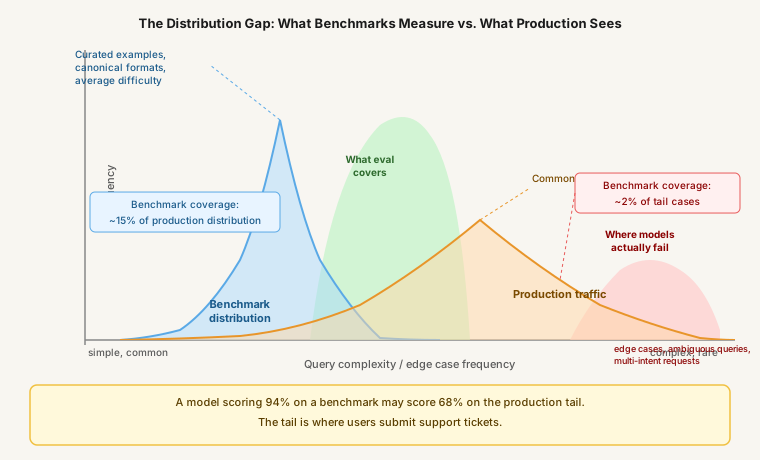
The gap compounds over time. Production traffic drifts as user behavior evolves, as the product surface area expands, as the model gets exposed to new domains through usage patterns you did not anticipate during development. A benchmark that was representative at launch becomes progressively less representative as months pass. The evaluation score stays stable (because it is static) while actual production behavior drifts. Teams discover this when user satisfaction metrics or support escalation rates start moving in the wrong direction, and a diagnostic investigation reveals that the model has been failing on a growing category of queries for months.
The structural problem is that benchmarks are built by humans who sample from the imaginable query space, and production traffic is generated by users who explore the full query space including the parts that humans systematically fail to imagine in advance. A benchmark that took a week to build represents a week's worth of human imagination about what users might ask. Six months of production traffic represents six months of actual user behavior.
Building held-out sets that actually matter
The right evaluation set is a stratified sample of real production traffic, not curated examples. If you have production traffic, sample from it directly. If you do not have production traffic yet (pre-launch), generate synthetic traffic that reflects the realistic distribution of user intents: sample from user research interviews, support tickets from comparable products, or use a language model to generate a diverse set of plausible queries that span the full intent taxonomy you have mapped for the product.
The taxonomy matters. For a customer support model, the intent taxonomy might include: account access and billing questions, product usage questions (simple and multi-step), complaint and escalation requests, out-of-scope requests (things the model should not handle), ambiguous queries that could fit multiple categories, and adversarial or unusual formulations of otherwise normal requests. Each of these represents a distinct distribution with distinct failure characteristics.
Structure the evaluation set along several axes simultaneously: intent category, query length distribution (short one-sentence queries through long multi-paragraph requests), formality level (casual conversational language through formal business writing), presence of domain-specific terminology, presence of named entities that require real-world knowledge, and failure scenario types such as genuinely ambiguous queries, edge cases at the boundary of what the model should handle, and adversarial inputs designed to probe safety and robustness. For each cell in this taxonomy, include enough examples to get a statistically meaningful signal. Thirty or more examples per cell is a reasonable floor; fewer than that and you cannot distinguish a real performance difference from sampling noise.
Measure performance separately for each cell, not just as an aggregate. A model that achieves 95% overall but 60% on long multi-intent queries is useless for that query type, and an aggregate score hides this entirely. The production traffic distribution determines which cells matter most, and that distribution should weight your aggregate metric. If 30% of your production queries are short billing questions and 10% are complex multi-step troubleshooting queries, your aggregate metric should weight the billing category three times as heavily as troubleshooting, not treat them equally.
One practical implementation: maintain a "drift sentinel" set, a fixed 100 to 200 example evaluation set sampled from early production traffic. Run it weekly. When the score on this set drops while your main evaluation score holds steady, that is a signal that production traffic has drifted away from the distribution the main set covers. The sentinel captures what users were actually doing in week one; if the model's performance on those queries deteriorates, something has changed.
LLM-as-judge: calibration and limitations
Using a stronger language model to evaluate the outputs of a weaker one has become standard practice, particularly for open-ended generation tasks where human evaluation is the gold standard but is too slow and expensive to run at scale. The GPT-4 judge pattern, where you submit the question, the candidate answer, and optionally a reference answer, and ask GPT-4 to rate quality on a 1-5 scale, achieves 70 to 85% agreement with human raters on factual and instruction-following tasks according to Zheng et al. (NeurIPS 2023). At scale, this is useful. For a 10,000-example evaluation set, human annotation might cost $5,000 to $10,000 and take two weeks. LLM-as-judge costs $50 to $100 and completes in hours.
This agreement rate sounds reasonable but has important failure modes that are systematic, not random. LLM judges are consistently biased toward outputs from their own model family: GPT-4 rates GPT-4 outputs higher than equivalent outputs from Claude or Mistral, even when human raters cannot distinguish quality differences. The bias is not enormous, typically 8 to 15 percentage points, but it is enough to invalidate comparisons between model families when the same judge is used for both. If you are using GPT-4 to compare GPT-4o against Claude 3 Sonnet, you are using a biased referee.
LLM judges are also biased toward longer answers regardless of content quality. An answer that says the same thing in twice as many words will score higher than the concise version in most LLM judge configurations, because the model has been trained on human feedback that associates comprehensiveness with quality. In production, verbosity is often a failure mode: a user who asked a simple question does not want three paragraphs. The judge scores the wrong thing.
Most critically, LLM judges are poor at detecting subtle factual errors and numerical mistakes. An answer that states a slightly wrong number, names the wrong year, or inverts the direction of a causal relationship will often receive the same score as a correct answer, because the judge relies on pattern-matching plausibility rather than external verification. The plausible-sounding wrong answer is the core failure mode of language models themselves, and a language model used as a judge has the same weakness.
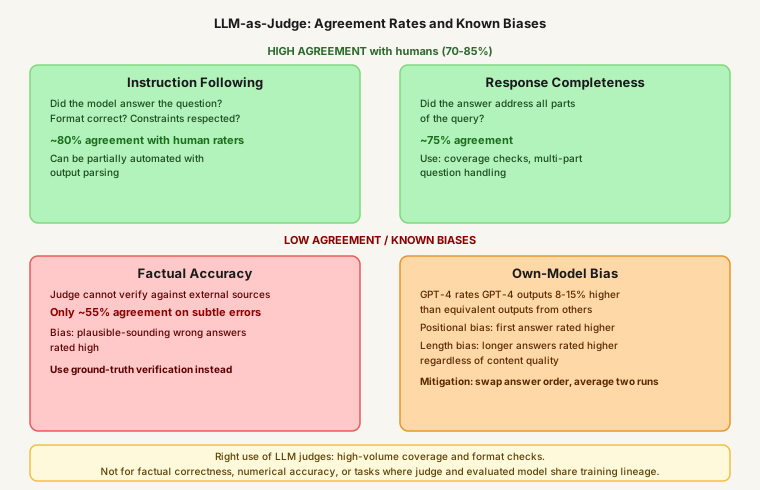
Use LLM-as-judge for coverage checks (did the model answer the question at all), instruction following (did it use the correct format and respect specified constraints), factual plausibility on common knowledge (does the answer sound plausible for questions with unambiguous standard answers), and fluency. Do not use it as the sole signal for factual accuracy on domain-specific knowledge, numerical correctness, reasoning chain validity, or production-critical behaviors where a subtle error has significant consequences.
Calibrate your judge before relying on it. Take a sample of 200 to 300 examples from your evaluation set, run human annotation, and compare human scores to judge scores. Calculate the agreement rate and identify where the judge systematically diverges from humans. Typical findings: the judge over-rates long answers by 0.5 to 0.8 points on a 5-point scale, under-detects factual errors by 15 to 20%, and exhibits own-model bias of 8 to 12%. Once you know the bias pattern, you can correct for it or route the high-stakes categories to human review.
For absolute scores (is this model good?), LLM judges are adequate if calibrated. For relative comparisons between two models of the same family, they are adequate if you run both orderings and average. For comparisons between model families, use human evaluation or a judge from a third family with no stake in the comparison.
Failure mode taxonomy: measuring the right things independently
Different failure modes have different root causes and different mitigations. Measuring them as a single aggregate accuracy score makes it impossible to diagnose what is wrong or apply the right fix. A drop from 87% to 82% overall accuracy is ambiguous: it could mean the model started hallucinating more facts, started refusing more legitimate queries, started producing malformed outputs, or started failing on multi-step reasoning. Each of those diagnoses points to a different part of the system and requires a different response. Aggregate accuracy gives you the fire alarm without telling you which room is burning.
The four failure modes worth measuring independently are factual hallucination, instruction failure, refusal error, and reasoning error.
Factual hallucination is when the model states something verifiably false. The root cause, as described in previous posts in this series, is usually either weak key-value associations in the FFN layers for sparse facts, absent training signal for post-cutoff information, or degradation in the retrieval pipeline if RAG is in use. Measurement requires external verification against ground truth: a held-out set of factual questions with known correct answers, evaluated by checking whether the model's stated answer matches the ground truth. TruthfulQA-style probes, which include questions that models commonly answer incorrectly due to popular misconceptions, are useful for detecting a specific class of confident hallucination.
Instruction failure is when the model ignores or partially follows a format or constraint specified in the system prompt or user query. This is largely a fine-tuning and prompt engineering failure: the model was not trained or prompted in a way that reliably produces the required output structure. Measurement is mostly mechanical: parse the model's output with a schema validator or output parser and count pass/fail. If the instruction requires JSON output, test whether the output is valid JSON. If it requires a maximum of 200 words, count the words. If it requires citing sources in a specific format, check whether the citation format matches. The advantage of this failure mode is that it is automatable without an LLM judge.
Refusal error is when the model refuses a legitimate request due to false positive safety triggers. This is one of the most damaging failure modes for user experience because it is visible and frustrating: the user asked a reasonable question and the model declined to answer as if the question were offensive or dangerous. Measurement requires a set of legitimately answerable queries that similar models handle correctly and that fall in areas where the model might have been over-calibrated during alignment. Route a sample of these through the model weekly and measure the refusal rate on queries that should not be refused.
Reasoning error is when the model's logic is flawed even when its factual premises are correct. This is the failure mode where the model has the right facts but draws the wrong conclusion. Measurement requires constructing chains of logic with known valid and invalid inferences: if-then chains, syllogisms, causal reasoning sequences. Present these as test cases where the correct answer is the valid logical conclusion, and evaluate whether the model reaches it. The evaluation requires either ground-truth logical answers (which can be generated by construction) or human raters who check the reasoning chain rather than just the conclusion.
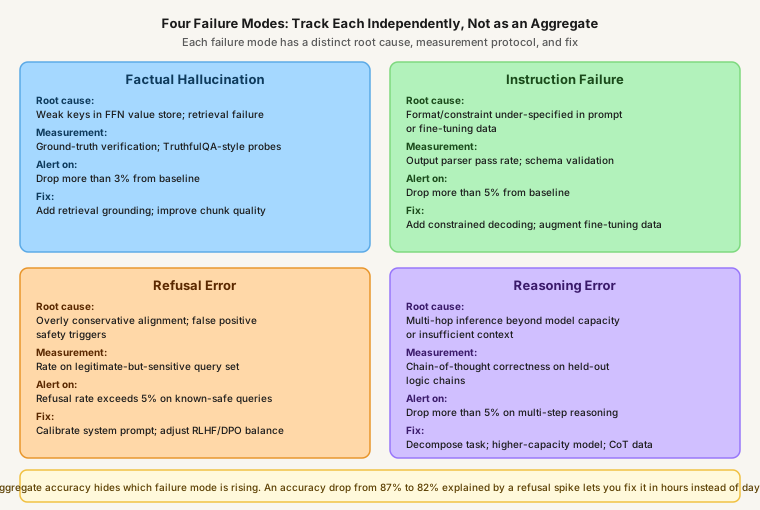
For production systems, instrument each of these failure modes independently and set alert thresholds. A spike in refusal errors that coincides with a model update points to an alignment calibration problem in the new version. A spike in factual hallucination that appears without a model change points to distribution shift in the input data or degradation in the retrieval pipeline. A gradual rise in instruction failure over several weeks, without a model change, often indicates that user query patterns have drifted away from the formats the model was fine-tuned on. None of these diagnoses are reachable from aggregate accuracy alone.
Evals as a CI gate, not a one-time measurement
The production model is not static. It gets updated when new versions are released, when fine-tuning is re-run on accumulated data, when the serving infrastructure changes, or when upstream data sources change. An evaluation pipeline that ran once before deployment tells you nothing about whether the model is still behaving correctly six months later. Treating evals as a one-time deployment gate is the same mistake as writing a test suite, running it once before shipping, and never running it again.
The right pattern is to treat your evaluation suite as a regression test: run it on every model version before promoting to production, maintain a history of scores per failure mode category, and set automatic rollback triggers when scores drop below thresholds. For a customer-facing model, a drop of more than 5 percentage points in instruction following rate on the core task taxonomy should trigger a rollback and investigation before users are affected. A drop in factual accuracy that correlates with a RAG index update should be caught before the index update goes live.
The continuous evaluation pipeline has four components. First, a versioned evaluation set that is stored alongside the model artifacts and does not change between runs, so that score comparisons between versions measure the model, not the evaluation data. Second, a per-failure-mode score history stored in a time-series database, not just a single latest-score field, so that trends are visible. Third, automated thresholds that block a new model version from being promoted if any failure mode score drops more than a configured amount from the previous version baseline. Fourth, a human review queue for cases where automated thresholds are triggered, so that the investigation happens before users see the regression, not after.
The cost of running evals frequently is real but small in absolute terms. At approximately $0.01 per evaluation call using GPT-4o mini as judge on a typical prompt, and a 1,000-example test suite, a single eval run costs $10. Running it on every model push at 10 pushes per week is $100 per week, or $5,200 per year. For a production system that affects real users, that is a trivially small fraction of the cost of a single production incident caused by an undetected regression. A customer support model that starts refusing 20% of legitimate queries because an alignment update went wrong will generate support escalations within hours. The cost of diagnosing and rolling back that incident, including engineering time, user churn, and support overhead, will far exceed a year's worth of continuous eval costs.
The deeper argument for continuous evaluation is that it changes the organizational relationship with model quality. When evals run once before launch and are then forgotten, model quality becomes a launch-time property that no one is responsible for maintaining. When evals run continuously and block promotions on regression, model quality becomes an ongoing operational responsibility with clear ownership. Teams that have made this transition consistently report that they catch regressions earlier, spend less time on root cause analysis (because the timing of the regression provides a strong diagnostic signal), and ship model updates with more confidence because they know the regression test will catch problems before users do.
References
Magar, I. and Schwartz, R. "Data Contamination: From Memorization to Exploitation." ACL Findings, 2022. https://arxiv.org/abs/2203.08242
Zheng, L., Chiang, W. L., Sheng, Y., et al. "Judging LLM-as-a-Judge with MT-Bench and Chatbot Arena." NeurIPS, 2023. https://arxiv.org/abs/2306.05685
Hendrycks, D., Burns, C., Basart, S., et al. "Measuring Massive Multitask Language Understanding." ICLR, 2021. https://arxiv.org/abs/2009.03300
Cobbe, K., Kosaraju, V., Bavarian, M., et al. "Training Verifiers to Solve Math Word Problems." arXiv, 2021. https://arxiv.org/abs/2110.14168
Jacovi, A., Goldman, O., and Goldberg, Y. "Contrastive Explanations for Model Interpretability." EMNLP, 2021. https://arxiv.org/abs/2103.01378
Guo, C., Pleiss, G., Sun, Y., and Weinberger, K. Q. "On Calibration of Modern Neural Networks." ICML, 2017. https://arxiv.org/abs/1706.04599