Embedding Models Are Not Interchangeable: Choosing One That Won't Sink Your RAG Pipeline
The embedding model is the part of a RAG pipeline that gets the least attention and causes the most silent failures. When retrieval quality degrades, teams first investigate the chunking strategy, then the vector database configuration, then the prompt. The embedding model is often the actual cause: a model trained on general web text retrieving from a legal or medical corpus, producing similarity scores that rank plausible but irrelevant chunks above the correct answer. The mistake is treating embedding models as interchangeable commodity components and selecting them by MTEB leaderboard rank rather than by domain fit.
The consequences are invisible in demos. A general-purpose embedding model on a mixed-domain question set will produce passable results because the hard cases, the ones that require the model to understand domain-specific terminology and distinguish semantically adjacent but contextually distinct passages, are not well-represented in casual evaluation. In production, those hard cases are the majority of queries, and that is where the gap between a leaderboard-optimized model and a domain-appropriate model becomes the difference between a useful system and one that generates fluent hallucinations backed by plausible but wrong retrieved context.
What MTEB actually measures and why it misleads
The Massive Text Embedding Benchmark (MTEB) evaluates embedding models across seven task categories: classification, clustering, pair classification, reranking, retrieval, semantic textual similarity (STS), and summarization. The aggregate score is a macro-average across all tasks and all datasets within each task. This aggregation is both the benchmark's strength and its principal weakness for RAG use cases.
A model that excels at STS but fails at retrieval can score well overall. STS datasets ask whether two sentences have equivalent meaning, a task that rewards models trained to compress semantic content into high-similarity vectors for paraphrases. Retrieval datasets ask whether a sparse, keyword-phrased query maps to a long, contextually rich passage, a structurally different problem where query and document have very different surface forms but high relevance. A model that achieves excellent STS scores and mediocre retrieval scores can produce an MTEB aggregate that looks strong. The aggregate has laundered away the distinction between tasks that matter for your pipeline and tasks that do not.
The second problem is domain shift within the retrieval task itself. Most high-performing MTEB models are fine-tuned on MS-MARCO, a web search dataset of roughly 500,000 query-passage pairs drawn from Bing search logs and Wikipedia passages. MS-MARCO is an excellent training set for web search retrieval. It is a poor proxy for biomedical literature retrieval, legal document search, financial report navigation, or scientific paper retrieval.
The BEIR benchmark (Benchmarking Information Retrieval) exposes this precisely. BEIR contains 18 diverse retrieval datasets including biomedical (TREC-COVID, NFCorpus), legal (FiQA, SciFact), and conversational (CQADupStack, FEVER) domains. Models that rank highly on MS-MARCO-style retrieval commonly show 15 to 25 percentage point recall drops on out-of-domain BEIR datasets. The recall@10 metric on in-domain versus out-of-domain retrieval tells you whether a model will actually work for your specific content. A model that achieves recall@10 of 82% on MSMARCO-Dev can fall to 58% on TREC-COVID without that drop appearing prominently in an MTEB aggregate that averages across dozens of datasets weighted by task category.
When selecting an embedding model for a production RAG system, the MTEB aggregate score is a starting filter, not a decision criterion. It tells you roughly which models are worth evaluating further. The decision criterion is task-specific performance on a corpus and query set that resembles your production data.
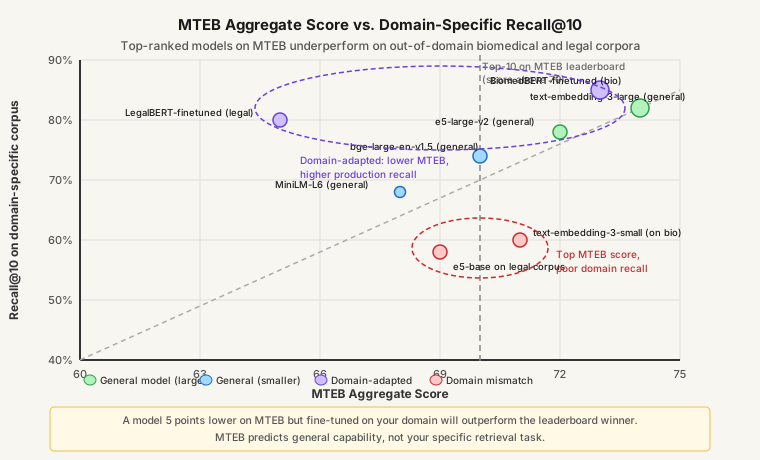
The scatter above illustrates the concrete problem. The top-right quadrant, high MTEB and high domain recall, is where you want to be. Domain-adapted models frequently occupy the upper-left: lower MTEB aggregate but substantially higher recall on the target corpus because their training distribution matches it. The red cluster represents models with strong MTEB scores deployed outside their training domain. Leaderboard rank predicts position on the horizontal axis well. It says nothing about the vertical axis.
Dimensionality and storage tradeoffs
Embedding dimensionality controls the density of the vector space and the storage cost at scale. The tradeoffs are concrete once you put numbers to them.
text-embedding-3-small (OpenAI): 1536 dimensions. At float32 and 1 million documents, the storage requirement is 1,536 x 4 bytes x 1,000,000 = 5.9 GB. At float16: 2.95 GB. This is manageable for most vector databases.
text-embedding-3-large (OpenAI): 3072 dimensions. At 1 million documents in float32: 11.8 GB. Twice the storage cost, with meaningfully higher recall on complex semantic tasks where the additional dimensions capture finer distinctions in the embedding space.
MiniLM-L6-v2 (sentence-transformers): 384 dimensions. At 1 million documents: 1.5 GB float32. Approximately 4x smaller than text-embedding-3-small at the cost of lower recall on hard retrieval tasks, where the compressed representation loses fine-grained semantic distinctions.
The practical concern for large-scale deployments is not just storage but ANN (approximate nearest neighbor) index size and query latency. HNSW indexes scale super-linearly with dimension: a 3072-dimensional index takes roughly 4x longer to query than a 768-dimensional index at the same recall level, because the inner product computation is more expensive and the graph traversal covers more high-dimensional neighbors before converging on the nearest points. At 100 million documents, the query latency difference between 384 and 3072 dimensions is meaningful. At 10 million documents under a 50ms latency budget, it is a constraint that eliminates some models before you even evaluate their accuracy.
The right dimensionality choice is determined by the intersection of accuracy requirements, corpus size, and query latency targets. A deployment that requires sub-10ms retrieval latency on 50 million documents and is constrained to CPU inference will reach for a 384-dimensional model regardless of what the accuracy leaderboard says. A deployment with a 200ms latency budget on 500,000 documents can afford 3072 dimensions and should if the task requires it.
Matryoshka Representation Learning
MRL (Kusupati et al., 2022) trains embedding models so that the first d dimensions of the full embedding are themselves a useful embedding at dimension d. A 1536-dimensional MRL embedding's first 256 dimensions can retrieve at quality close to the full 1536-dimensional embedding on most tasks, with less than 3% recall loss and 6x storage reduction. OpenAI's text-embedding-3 models support this directly: you can request a 256-dimensional embedding and trade a small quality loss for dramatic cost and storage savings without re-embedding your corpus.
The mechanism is a nested training objective. The loss is computed not just at the full dimension but at each of several truncation points, for example 64, 128, 256, 512, and 1536. The model learns to pack the most useful information into the early dimensions, because the gradient signal at every truncation point forces those early dimensions to carry maximum retrieval signal independently. The result is a family of embeddings of different sizes that share a corpus index: you can switch from 1536 to 512 dimensions at query time without re-embedding your corpus, which is valuable for A/B testing retrieval quality versus latency.
The early dimensions behave like a compressed summary: the model has learned to concentrate the coarse semantic signal (topic, domain, general intent) into the first 64 to 128 dimensions, with the remaining dimensions adding progressively finer distinctions. This is not an accident of training but a designed property, which is why the quality degradation curve for MRL models at truncated dimension is much flatter than for models that are naively dimensionality-reduced by PCA after the fact.
For production systems with memory or cost constraints, MRL models enable a practical strategy: embed at full dimension, store the truncated version for retrieval, and use the full dimension only for the final reranking step where the candidate set is small. The corpus footprint uses the compact representation; accuracy-critical scoring uses the full representation. This is not a hypothetical optimization but a supported workflow in OpenAI's text-embedding-3 API, where you specify the dimensions parameter per request.
Two-stage retrieval: bi-encoder and cross-encoder
A bi-encoder embeds the query and each document independently, then computes similarity by dot product or cosine. This is the standard embedding model paradigm: fast because similarity is a single vector operation, scalable because document embeddings are precomputed, but limited by the constraint that query and document representations cannot interact during encoding. The model must compress each text into a fixed-size vector without knowing what query will arrive, which means the similarity computation operates on independently compressed representations rather than on the interaction between the query and document texts.
A cross-encoder takes the query and document concatenated as input and produces a relevance score directly, allowing the model to attend to query-document interactions. The attention mechanism can identify whether specific phrases in the query match specific claims in the document, whether the query's implied information need is satisfied by the document's content, and whether the topical overlap is substantive or incidental. Cross-encoders produce much more accurate relevance scores, but they cannot precompute document representations: every query-document pair requires a full forward pass, making them O(n) in the number of documents and unusable as the primary retrieval mechanism for corpora larger than a few thousand documents.
Two-stage retrieval uses both. The bi-encoder retrieves the top-k candidates, typically k = 20 to 100, in milliseconds. The cross-encoder reranks those candidates in 100 to 500ms total, producing a final ranked list. The quality improvement from the cross-encoder reranking step is substantial on hard retrieval tasks: on BEIR benchmarks, two-stage systems achieve 15 to 30% higher NDCG@10 than bi-encoder-only retrieval. The cross-encoder does not need to be accurate across the full corpus; it only needs to correctly sort the candidates the bi-encoder surfaces, which is a much easier task because all of those candidates are already topically relevant.
The latency budget for this approach on production systems is straightforward. Bi-encoder retrieval from a 10 million document HNSW index takes 5 to 20ms. Cross-encoder reranking of 50 candidates takes 100 to 200ms on a GPU (1 to 3ms per pair in a batched forward pass on a 200M-parameter cross-encoder). Total: 120 to 220ms, well within a 500ms response latency target. The cross-encoder inference is batched: all 50 candidate pairs are scored in parallel in a single forward pass through the model, so the per-candidate cost amortizes across the batch. At batch size 50 with a 200M-parameter cross-encoder on a single A10G GPU, you can rerank in roughly 80 to 150ms.
The right mental model for two-stage retrieval: the bi-encoder is a high-recall filter that efficiently shrinks the candidate set from millions to tens. The cross-encoder is a high-precision scorer that correctly orders that small candidate set. Each stage does what it is good at.
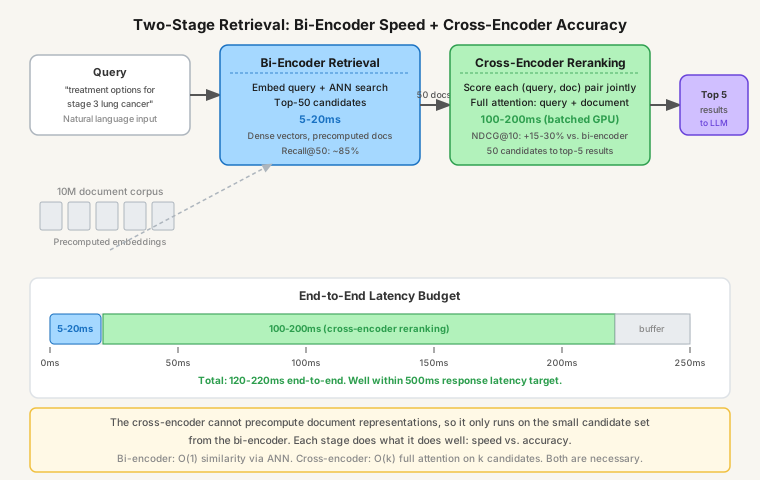
The most common mistake in implementing two-stage retrieval is choosing k too small for the bi-encoder stage. If the correct document is not in the bi-encoder's top-50 results, the cross-encoder cannot recover it. The bi-encoder recall@k needs to be high enough that the cross-encoder has the correct answer to work with. For hard retrieval tasks, bi-encoder recall@50 is typically 75 to 90%, meaning 10 to 25% of queries never have the correct document in the candidate set regardless of how good the reranker is. Increasing k to 100 or 200 improves coverage at the cost of more cross-encoder inference time, which is a calibration decision made against your latency budget.
Domain drift and when to fine-tune
When your content domain does not match the embedding model's training distribution, fine-tuning can recover substantial recall. The pattern from practical deployments is consistent: a general-purpose embedding model on medical literature achieves recall@10 in the range of 55 to 65%. After fine-tuning on in-domain (query, relevant document) pairs, recall@10 rises to 75 to 85%. The same pattern holds in legal and financial domains, where specialized vocabulary, citation structures, and query formulations diverge significantly from web search patterns.
The minimum data requirement for embedding model fine-tuning is lower than for generative model fine-tuning. 1,000 to 5,000 (query, positive passage) pairs, with hard negatives generated by retrieving plausible but incorrect documents from your corpus using the base model, is typically sufficient to close most of the domain gap. Hard negatives are critical: training only on (query, positive) pairs without negatives teaches the model to pull positives closer but does not teach it to push away documents that are semantically adjacent but contextually wrong. A biomedical model that has not seen hard negatives will rank similar-sounding but clinically distinct passages as highly relevant, exactly the failure mode that domain fine-tuning is meant to address.
The training objective is typically a contrastive loss such as InfoNCE or MultipleNegativesRankingLoss. The query embedding and positive passage embedding are pulled together in the vector space while the hard negatives are pushed away. The loss magnitude from hard negatives is higher than from random negatives because hard negatives are already relatively close in the base model's embedding space, requiring more gradient signal to separate. This is why a training set with 2,000 hard-negative triplets outperforms one with 20,000 random-negative pairs: the information density per training example is higher.
When you lack labeled data entirely, an LLM can generate synthetic query-document pairs from your corpus. Given a document passage, ask a model to generate 3 to 5 questions that this passage could answer. The resulting (question, passage) pairs can be used directly for fine-tuning. Quality is lower than human-labeled pairs but substantially better than no fine-tuning. The practical result from several production deployments: synthetic data fine-tuning on a medical corpus moves recall@10 from approximately 58% (base model) to approximately 71% (fine-tuned on synthetic data), compared to approximately 81% for a model fine-tuned on human-labeled pairs. Getting from 58% to 71% with zero labeling cost is a worthwhile improvement even when human labels are the eventual goal.
Fine-tuning also allows you to encode domain-specific query formulations that the base model has not seen. Medical practitioners query with clinical terminology; patients query with lay language for the same concepts. A fine-tuned model trained on both query styles against the same document corpus learns to map both formulations into overlapping regions of the embedding space, which is something a general-purpose model cannot achieve because it has no training signal specific to that relationship.
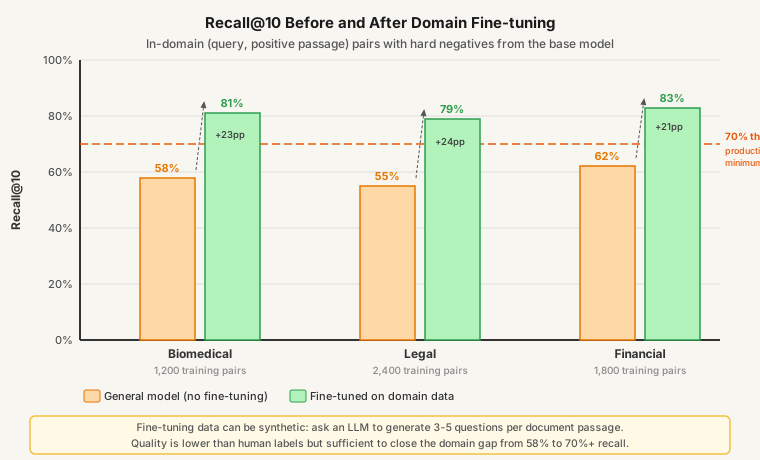
The data efficiency curve flattens after approximately 5,000 high-quality training pairs. Beyond that point, additional pairs produce diminishing recall improvements, and the effort is better spent on corpus quality, chunking strategy, or reranker improvement. The exception is when the domain has many distinct subdomain clusters that each require separate coverage: a medical corpus covering cardiology, oncology, and nephrology will benefit from training data that represents all three clusters, so total data requirements scale with subdomain diversity rather than overall corpus size.
Evaluation protocol for production
The evaluation protocol that predicts production performance has four components, and skipping any one of them introduces a systematic blind spot.
The first component is constructing a query set that mirrors real production queries. For a deployed product, sample from actual user queries with personally identifiable information removed. For a pre-launch product, generate synthetic queries using the technique above or gather them from domain experts who can formulate queries the way real users will. The query set must include both head queries (common, well-formed, topic-aligned) and tail queries (ambiguous phrasing, cross-domain references, colloquial terms for technical concepts). Head queries will be handled well by almost any model; tail queries separate good models from adequate ones.
The second component is manually identifying the relevant documents from your corpus for each query in the evaluation set. This is the ground truth. For a corpus of thousands to tens of thousands of documents, this can be done by domain experts reviewing a candidate set produced by multiple retrieval systems simultaneously. For larger corpora, a pooling strategy collects the top-k results from multiple retrieval methods and has annotators label only that pool. The minimum set size for statistically meaningful results is 100 queries; 300 or more gives stable metric estimates. Fewer than 100 queries produces evaluation noise that can hide model differences of 5 to 10 percentage points in recall.
The third component is measuring recall@k at k = 1, 5, 10, and 20. Recall@10 is the most predictive of end-to-end RAG quality because a retrieval system that surfaces the right document in its top 10 results can almost always be made to produce the correct final answer with good reranking and prompting. Recall@1 is too strict for practical use: many relevant documents are legitimately equivalent, and insisting the model place a specific document first is not a meaningful production requirement. Recall@20 is too lenient: if you are passing more than 20 chunks into the generation context, you have a different problem with context utilization rather than retrieval.
Complementing recall, NDCG@10 (Normalized Discounted Cumulative Gain) captures ranking quality within the top-10 results. Two retrieval systems with identical recall@10 can have different NDCG@10 if one consistently places the most relevant document at position 2 and the other at position 8. For RAG pipelines with a reranker, NDCG@10 of the bi-encoder stage is less important because the reranker corrects the ordering. For pipelines without reranking, NDCG@10 is the metric you optimize.
The fourth component is measuring end-to-end answer quality on a held-out subset of queries, using either human raters or an LLM judge, to confirm that retrieval quality improvements translate to answer quality improvements. This validation is necessary because improving recall does not always improve answer quality. If the generative model cannot effectively use retrieved content due to context window limitations, attention dilution from too many retrieved chunks, or a mismatch between the retrieved document format and what the prompt expects, fixing retrieval is not enough. Conversely, if the end-to-end quality is already acceptable on the evaluation set, spending engineering effort on marginal retrieval improvements is misallocated.
The LLM judge evaluation uses a model to score each generated answer against the ground truth on dimensions like factual correctness, completeness, and relevance. The correlation between LLM judge scores and human ratings is typically 0.8 to 0.9 on factual tasks, which is high enough to be useful for model selection decisions but not high enough to substitute for human evaluation at launch time. Use LLM judge scoring for iterative development and human evaluation for final validation before production deployment.
The full evaluation pipeline reduces to this: build a representative query set, annotate relevant documents, measure recall@10 across candidate embedding models, validate improvements end-to-end. This is not expensive: 300 annotated queries, a two-hour annotation session with a domain expert, and an afternoon of retrieval evaluation runs will tell you more about which embedding model belongs in your production system than any amount of MTEB leaderboard analysis.
References
Muennighoff, N., Tazi, N., Magne, L., and Reimers, N. "MTEB: Massive Text Embedding Benchmark." EACL, 2023. https://arxiv.org/abs/2210.07316
Thakur, N., Reimers, N., Rücklé, A., Srivastava, A., and Gurevych, I. "BEIR: A Heterogeneous Benchmark for Zero-shot Evaluation of Information Retrieval Models." NeurIPS, 2021. https://arxiv.org/abs/2104.08663
Kusupati, A., Bhatt, G., Rege, A., et al. "Matryoshka Representation Learning." NeurIPS, 2022. https://arxiv.org/abs/2205.13147
Nogueira, R. and Cho, K. "Passage Re-ranking with BERT." arXiv, 2019. https://arxiv.org/abs/1901.04085
Karpukhin, V., Oguz, B., Min, S., et al. "Dense Passage Retrieval for Open-Domain Question Answering." EMNLP, 2020. https://arxiv.org/abs/2004.04906
Wang, L., Yang, N., Huang, X., et al. "Text Embeddings by Weakly-Supervised Contrastive Pre-training." arXiv, 2022. https://arxiv.org/abs/2212.03533